Author: Slava Zhiradkov

  • Your School, Your Brand: Why White-Label Shouldn’t Be a $150/Month Upgrade

    Included from day one

    Your school, your brand. White-label shouldn’t be a $150/month upgrade.

    Most education platforms treat your brand as a paid feature. eTalk.ai white-labels every account from the moment it’s created — on every plan, at no extra charge.

    Your own domainYour logo & coloursBranded emails & invoicesNo “Powered by” badgeNo setup fee

    You sign up, import your students, build your schedule — and then discover that the login page your families see carries someone else’s logo. Removing it costs extra. Usually a lot extra: white-label tiers across the market typically start around $150/month and climb from there, often with a setup fee attached.

    At eTalk.ai, white-label is included. Not on the top plan. Not after a sales call. From day one, on every plan, at no additional charge.

    This post explains what white-label actually means (the term is used loosely, and the gaps matter), why so many platforms charge for it, what that surcharge really costs over a few years, and the questions worth asking any vendor before you sign.

    “White-label” is four different things

    Vendors use one word for four very different levels of branding. When you compare platforms, compare at this level of detail — otherwise you’re comparing a logo upload to a genuinely branded product.

    Often “branded”Level 1 — Cosmetic brandingYou upload a logo and pick a couple of colours. The platform’s name still appears in the page title, the footer, the login screen, or a “Powered by” badge. This is where most free tiers stop.
    Level 2 — Your domainFamilies reach the platform at portal.yourschool.com, not yourschool.vendorname.com. The URL is the most visible branding in the entire experience — in every link you send, every bookmark a parent saves, every address bar during a payment.
    Level 3 — Your communicationsEnrollment confirmations, class reminders, invoices, and password resets arrive from your school, not the vendor. Parents forward these emails to each other — they land in inboxes far beyond your student list.
    eTalk.ai standardLevel 4 — End-to-endNo vendor name anywhere a student or parent can see. Consistent branding on the learning environment, checkout, receipts, and mobile. A family could use your school for two years and never learn which software you chose.

    The gap between Level 1 and Level 4 is where the money is. Many platforms sell Level 1 as standard, then price Levels 2 through 4 as a premium add-on — because once your students are inside the system, the branding gap is uncomfortable enough that you’ll pay to close it.

    Why platforms charge for it

    Not out of malice. Usually one of three reasons:

    It’s a pricing lever, not a cost

    Once a platform supports custom domains, serving one more branded tenant costs close to nothing. But branding is emotionally important and easy to isolate as a line item. It’s the checked-bag fee of education software.

    The architecture wasn’t built for it

    Platforms that bolt multi-tenancy on later need a human to do branding setup by hand. That’s a real cost — but one created by the original design decision, and you pay it monthly rather than once.

    Their growth depends on your visibility

    A “Powered by” badge on your student portal is a free acquisition channel. Every parent who sees it is a potential lead. Charging you to remove it means you’re paying to stop being a marketing surface.

    What the surcharge actually costs you

    Run the arithmetic before dismissing it as a small monthly line.

    $0
    Per month
    $0
    Per year
    $0
    Over three years

    Then add the extras that commonly ride along: a one-time setup fee, a per-additional-domain charge if you run more than one location or brand, sometimes a separate fee for a branded mobile presence, and occasionally a jump to an annual enterprise contract to access branding at all.

    For a mid-sized tutoring center, that’s a part-time tutor’s wages. And it buys you nothing operationally — not one extra feature, not one extra student seat. It buys the absence of someone else’s logo.

    There’s a second cost that never appears on the invoice. While you’re on the non-branded tier — during your trial, your first term, your first hundred students — every family you onboard is being introduced to your vendor’s brand alongside yours. You can’t retroactively un-show that. Branding is worth the most at the beginning, which is exactly when most platforms withhold it.

    Interactive

    What would branding cost you elsewhere?

    Drag the sliders to match the quote you’re looking at.

    Typical platform
    $5,900
    eTalk.ai
    $0
    You’d keep $5,900 — branding is included on every eTalk.ai plan.

    How eTalk.ai handles it

    Every eTalk.ai account is white-labeled from the moment it’s created: your domain for the student and parent portal; your logo, colours, and typography across the portal, course catalog, and checkout; your name on enrollment confirmations, reminders, invoices, and receipts; no eTalk.ai branding in the student- or parent-facing experience and no “Powered by” badge anywhere; no setup fee and no plan gate.

    We can include it because the platform was multi-tenant from the first line of code. Branding in eTalk.ai is configuration, not a services engagement — you set it in your admin panel and it applies everywhere. There’s no manual work on our side to recover, so there’s nothing to bill you for.

    Our pricing is a flat platform plan plus usage-based add-ons for the things that genuinely cost money as you grow: video minutes, AI tokens, and certain third-party integrations. Those scale with consumption because our costs scale with consumption. Your brand doesn’t consume anything.

    Branding capabilityTypical platformseTalk.ai
    Logo and coloursUsually includedIncluded
    Custom domainPaid tier, commonly $150+/moIncluded
    Branded emails and invoicesPaid tier or add-onIncluded
    “Powered by” badge removedPaid tierNo badge to begin with
    Setup fee for brandingCommonNone
    Available on the entry planRarelyYes

    Comparison reflects common patterns in white-label pricing across education platforms as of publication; individual vendors vary, and we’d encourage you to verify current terms directly with any platform you’re evaluating.

    If you resell or run schools for clients

    Agencies, franchise operators, curriculum providers, and consultants have a harder version of this problem. You’re not branding one school — you’re branding many, and the per-tenant fee multiplies. Ten client schools at $150/month is $18,000 a year in branding charges alone, before you’ve delivered any service.

    eTalk.ai’s branding model doesn’t change under that load. Each school you run gets its own domain, visual identity, and communication templates, with no per-brand surcharge. If you’re building a business on top of the platform rather than just using it, that difference compounds fast — worth a conversation about your specific setup.

    Twelve questions to ask any vendor

    Work through these in your evaluation. The answers separate real white-label from a logo upload quickly.

    0/12
    Vendor due-diligence checklistTick them off as you get answers. Nothing is saved or sent.

    If question 12 produces a number above zero, ask why.

    See it with your own branding before you decide

    Thirty minutes, and you’ll leave knowing exactly what your school looks like running on eTalk.ai — your domain, your logo, your email sender.

    Your students should see your school. That shouldn’t be an upgrade.

  • Market Fit: The Rule Every School Owner Knows But Few Ever Feel

    Market Fit: The Rule Every School Owner Knows But Few Ever Feel

    Most founders know the rule: a strong team with a great product still loses to a bad market. Every startup book repeats it. Every conference panel says it. But knowing the rule and feeling it firsthand are two very different things — and that gap is what costs education businesses years of runway and hundreds of thousands of dollars in wasted spend.

    If you run a tutoring business, a language school franchise, or a corporate L&D program, this isn’t abstract startup theory. It’s the difference between a course that scales past your first cohort and one that quietly stalls at twenty students. Here’s how the trap forms, and what to watch for before you build your next program, brand, or platform around it.

    Your First Students Aren’t a Market

    A small cluster of early adopters inside a dashed circle — a promising signal, not a market

    When your first few students or corporate clients sign up fast and easily, it feels like validation. Often it isn’t — it’s coincidence. Every niche has a small group of people with an urgent, specific pain who will pay for a solution the moment it appears. They find you. They convince their own manager or spouse. They sign the contract without being sold.

    The problem is that group might be five people. Or fifteen. And then it stops. Research from First Round Capital found that roughly 70% of startups that close early deals never manage to turn them into repeatable sales. Your first enrolled class or first pilot cohort proves the product works. It proves nothing about how many more of them exist.

    For a school owner, this shows up as: three enthusiastic parents who found you through a Facebook group, or one department head who pushed a training pilot through on personal conviction. That’s a promising signal — not a market.

    The Difference Between a Learner’s Problem and a Company’s Problem

    One bar crossing the pain threshold line — only business-level pain opens budgets

    This is the least obvious and most important distinction in B2B education sales — especially in corporate training. An employee struggling with a skill gap doesn’t mean their company is ready to pay for a fix. Businesses open their budget only when the pain becomes unbearable at the business level — when it’s hurting revenue, compliance, retention, or reputation.

    If the problem just annoys a few employees but the company can live with it, it will keep living with it. No demo, no discount, and no persistence from your sales team will change that math. This is why the right question isn’t “are there employees with this skill gap.” It’s “are there companies for whom this skill gap is a business risk they can’t afford to ignore.”

    The same logic applies to consumer education. A parent who’s mildly unhappy with their kid’s grades is not the same as a parent whose child is about to fail a certification exam. One browses. The other buys.

    A Great Salesperson Won’t Save a Bad Market

    When enrollment or corporate contracts stall, the first instinct is almost always: hire a stronger salesperson. It’s an understandable reaction, and it rarely fixes anything. If founders with deep knowledge of the product and the market can’t close deals themselves, a hired salesperson usually can’t either. A great sales hire scales a system that already works — they don’t build one from nothing in a market that isn’t there.

    According to Harvard Business Review, roughly 65% of sales failures trace back not to team quality but to a mismatch between product and market. So if your outreach, demos, and pilot offers have been running for months with no repeatable pattern emerging, the signal points at the market — not at your admissions or sales team.

    A Shrinking Market Is a Verdict, Not a Challenge

    A declining market trend line with a lone player pushing against it

    There’s another trap that’s easy to fall into: building a program around a subject, certification, or technology that’s already fading. It feels like the answer is more marketing spend or a better curriculum, and attention will come back. In practice, pulling learners or companies back toward something they’re already moving away from is nearly impossible. The market moves forward, and no single school or platform reverses that current.

    If your enrollment niche — a specific language, a specific certification track, a specific corporate skill — isn’t growing or is visibly shrinking year over year, that’s not a challenge to push through with better execution. It’s a fact to accept and plan around.

    Recognizing It Early Is Your Advantage

    The single most valuable thing you can do once you’re in this situation is admit it as early as possible. That’s psychologically hard — there’s always the temptation to try one more channel, hire one more person, wait one more quarter. But every extra month costs money, time, and team energy.

    Education businesses that quickly recognize a market isn’t working and pivot — to a new subject, a new segment, a new delivery format — keep the thing that matters most: the resources to try again. The ones that hold on until the last dollar usually just close. Fast, disciplined execution gives you one critical asset: clarity. You see what isn’t working sooner, and you can act on it sooner.

    The Questions Worth Asking Before You Build Further

    Before investing deeply into a new course, franchise territory, or corporate training vertical, it’s worth answering honestly:

    Are there companies or learners for whom this problem is genuinely critical — not just inconvenient, but urgent? Are they willing to pay for a solution now, not “eventually”? Is the market growing, or at least holding steady? And do your first enrollments or contracts repeat — or were they rare exceptions?

    If any one of these doesn’t have a clear, confident yes, that’s a reason to pause and think before moving further — not a reason to push harder on execution.

  • Should You Build Your Own Tutoring Platform — or Use eTalk.ai?

    At some point, nearly every growing tutoring business asks the same question: “Should we just build our own platform?” It’s a tempting idea. You’d have full control over features, no monthly subscription, and software shaped around exactly how you work.

    We built eTalk.ai because we lived that journey — and we want to be honest with you about what it actually looks like.

    This article walks through the real trade-offs between building a custom tutoring platform and adopting a purpose-built SaaS like eTalk.ai, so you can make the decision with clear eyes.

    The Appeal of Building Your Own Platform

    Let’s give the “build it yourself” camp a fair hearing, because there are genuine upsides — in specific situations.

    Complete control over every feature

    When you build in-house, every workflow is designed around your business, not someone else’s assumptions. If your operation has genuinely unusual requirements that no existing platform addresses, custom software can be the right call.

    No recurring subscription fees

    Once built, your own software has no monthly bill. For very large operations at significant scale, this might look attractive on paper.

    A potential product business on the side

    Some tutoring companies that build internal tools end up discovering there’s a market for them among other businesses. It’s rare — but it happens.

    “Building your own software makes most sense when your business demands precision or innovation that simply doesn’t exist in the market.”

    The key phrase there is simply doesn’t exist. For the vast majority of tutoring businesses, the features they need already exist — and have been polished over years of real-world use.

    The Real Cost of Building a Tutoring Platform

    Building custom software is almost always slower, more expensive, and more complicated than anyone anticipates going in. Here’s a realistic picture of what a functional tutoring platform actually requires:

    Cost ItemEstimated Range
    Backend developer (contract, 6–9 months)$60,000–$90,000
    Frontend developer$40,000–$60,000
    UI/UX design$8,000–$20,000
    QA, testing, bug fixes$10,000–$20,000
    Infrastructure, hosting, security audits$5,000–$15,000/yr
    Payment integration (Stripe, compliance)$5,000–$10,000
    Video/live class infrastructure$8,000–$20,000
    Realistic Year-1 Total$136,000–$235,000+

    And that’s before you account for the opportunity cost — every hour you spend designing, testing, and managing software is an hour not spent teaching, growing your client base, or improving your service. The platform doesn’t stop needing attention after launch. Maintenance, security patches, compliance updates, and new features are ongoing forever.

    There’s also the timeline reality: a functional platform with scheduling, invoicing, payment processing, client portals, AI-powered learning tools, and reporting is not a six-week project. It’s a six-figure, multi-year commitment — and most builds run over schedule.

    Build vs. eTalk.ai: A Direct Comparison

    DimensionBuild Your OwneTalk.ai SaaS
    Time to launch❌ 6–18 months✅ Live in days
    Upfront cost❌ $100k–$200k+✅ Starts free (solo tutors)
    Ongoing maintenance❌ Your team’s problem✅ Handled by eTalk.ai
    White-label branding✅ Fully custom✅ Your domain, logo, colors
    AI-powered LMS⚠️ Must build from scratch✅ Built-in (PDF → curriculum)
    Scheduling & attendance⚠️ Months to implement well✅ Ready on day one
    Payments & invoicing⚠️ Stripe integration is non-trivial✅ Stripe built-in + tutor payouts
    Live, self-paced & blended classes❌ Complex video infrastructure✅ All three modes supported
    CRM (students, tutors, referrals)⚠️ Must design and build✅ Full CRM included
    Chat, SMS & email notifications❌ Multiple third-party services✅ Built-in, unified
    Security & GDPR compliance⚠️ Your responsibility✅ Managed and maintained
    Integrations (HubSpot, GoHighLevel…)⚠️ Must build each one✅ Supported with implementation help
    Unique proprietary advantage✅ Possible, if truly differentiated❌ Shared platform

    The “Frankenstein Stack” Problem

    Many tutoring businesses don’t jump straight to building. Instead, they cobble together a patchwork of tools: Calendly for scheduling, Stripe for payments, Google Drive for materials, WhatsApp for communication, and a spreadsheet for tracking everything else.

    It works — until it doesn’t. These tools don’t talk to each other, data lives in five different places, and subscription costs quietly stack up. When you add the time spent manually syncing information across platforms, you’ve created a part-time admin job that didn’t need to exist.

    This is usually the moment businesses start wondering whether to build their own platform. But the answer isn’t to build — it’s to consolidate onto one that already works.

    What eTalk.ai Gives You on Day One

    eTalk.ai is a fully white-labeled SaaS platform built specifically for tutoring businesses, language schools, and online academies. Under your own brand — your domain, your logo, your colors — you get:

    • Student & tutor CRM
    • Scheduling & attendance
    • Stripe payments & tutor payouts
    • AI-powered LMS — drop a PDF, get a full curriculum
    • Live, self-paced, and blended learning modes
    • Built-in chat, SMS & email notifications
    • Your own domain and branded portal

    The platform is designed to scale with you — from a solo tutor managing a handful of students, to a multi-location academy running hundreds of sessions a week. There’s no infrastructure to manage, no security team to hire, and no patch cycle to track.

    We Help You Connect to the Tools You Already Use

    One of the most common concerns tutoring businesses have when evaluating SaaS platforms is: “What about all the other tools we rely on?” It’s a fair question. Your CRM, marketing automation, or sales pipeline might live somewhere else — and you don’t want to give that up.

    With eTalk.ai, you don’t have to. We actively help businesses integrate with the tools they already have. Whether you’re running marketing campaigns through HubSpot, managing leads in GoHighLevel, automating outreach through a CRM, or connecting to any number of other platforms — we can implement those integrations for you.

    Integrations we commonly help with: HubSpot, GoHighLevel, Zapier / Make, Google Calendar, Zoom, Stripe, Mailchimp / ActiveCampaign, Slack, WhatsApp Business, Pipedrive, and more on request.

    Rather than building and maintaining API connections yourself — which takes engineering time and breaks when third-party APIs change — our team handles the implementation. You describe what you need your tools to do together, and we make it happen.

    When Does Building Your Own Actually Make Sense?

    We want to be fair. There are scenarios where custom software is the right choice:

    You have requirements that genuinely don’t exist anywhere. If your business model is structurally unlike any other tutoring or education business — unusual enough that no existing platform can serve it — custom software might be justified. But be honest with yourself: most “unique” requirements are well-served by existing platforms once you look closely.

    You’re building a software business, not a tutoring business. If your primary goal is to create a platform to license to other companies, then yes — you’re in the software business. But that’s a different mission than running a tutoring school.

    You have an existing engineering team with capacity. If you already have developers on payroll who have genuine spare capacity, the marginal cost of building is lower. Even then, think carefully about ongoing maintenance versus what that team could spend their time on instead.

    The Verdict

    Building your own tutoring software is one of those ideas that sounds empowering until you’re six months in, over budget, and still missing half the features you needed on day one. The hidden costs — developer salaries, QA time, security, compliance, infrastructure, and the constant pull of maintenance — add up fast and never stop.

    For the overwhelming majority of tutoring businesses, whether you’re a solo tutor, a growing academy, or a multi-branch school, adopting a proven, purpose-built platform is faster, safer, and far more cost-effective than building from scratch.

    eTalk.ai gives you a white-labeled platform that looks and feels like your own — without the six-figure build cost, the multi-month timeline, or the engineering overhead. And if you need it wired into your existing tools, we’ll handle that too.

  • Which Tech Stack Should Your Language School Franchise Choose?

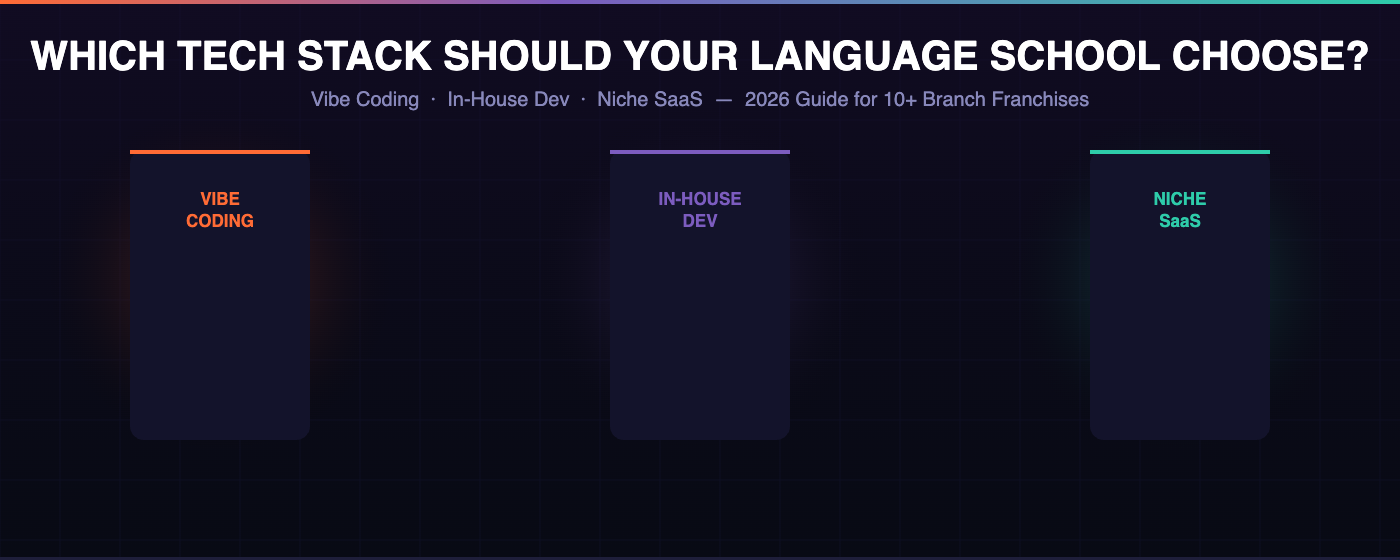
    Vibe Coding vs In-House Dev vs Niche SaaS — Tech Stack Comparison for Language School Franchises

    You run 10 language school branches — or you’re about to. Student management, scheduling, payments, LMS, and reporting across every location don’t fit inside a spreadsheet anymore. Three realistic paths sit in front of you: build it with AI (Vibe Coding), hire a dev team (In-House Development), or buy a purpose-built platform (Niche SaaS like eTalk.ai). This is an honest, side-by-side comparison.


    Why tech choice matters more at 10+ branches

    A single-location language school can survive on Calendly + Stripe + Google Sheets. At 10 branches the math breaks down: you’re juggling 10× the scheduling conflicts, 10× the teacher payroll calculations, 10× the student billing disputes — and your admin team can’t absorb the overhead without a system.

    The tech decision you make now will either unlock your next 20 locations or quietly eat 30% of every manager’s workday for the next three years. The wrong call is expensive; the right one is almost invisible.

    The hidden cost most owners miss: Every hour a branch manager spends on manual data-entry is an hour not spent on enrollment, retention, or teacher quality. Technology debt accrues like interest — silently, until it can’t be ignored.


    The three realistic options

    Vibe Coding

    AI-assisted dev (Cursor, Bolt, Replit)

    Low cost High risk
    Speed to v1Fast
    ReliabilityLow
    ScalabilityLow
    3-yr costMedium
    🏗

    In-House Dev

    Dedicated engineering team

    Custom Expensive
    Speed to v1Slow
    ReliabilityHigh
    ScalabilityHigh
    3-yr costVery High

    Niche SaaS

    e.g. eTalk.ai white-label

    Ready now All-in-one
    Speed to v1Days
    ReliabilityHigh
    ScalabilityBuilt-in
    3-yr costLow

    ⚡ Option 1: Vibe Coding

    Vibe coding — using AI-powered editors like Cursor, Bolt, Lovable, or Replit Agent to generate an entire application from plain-English prompts — has exploded in 2025–26. A non-technical founder can prototype a scheduling app in a weekend. The appeal for a growing school network is obvious: no agency fees, no waiting on a development team, rapid experimentation.

    What vibe coding is actually good at: landing pages, simple intake forms, marketing microsites, internal dashboards with read-only data. It excels where the blast radius of a bug is small and the feature set is narrow.

    Where it breaks for a 10-branch franchise

    The moment you need multi-tenant data isolation (branch A can’t see branch B’s students), role-based access control, payment reconciliation across locations, or a reliable SMS notification pipeline — vibe-coded systems hit a wall. The AI generates plausible-looking code that often has subtle security holes, no test coverage, and no documented architecture. When something breaks at 11 PM before a major intake, there’s no support to call.

    The hidden cost: franchises that started with a vibe-coded MVP typically spend 6–18 months later paying a contractor $80–150/hr to untangle what the AI built. The “free” prototype becomes a $60,000+ rewrite.


    🏗 Option 2: In-House Development

    Hiring a team to build your own school-management platform sounds like the premium option — complete control, built exactly to your specs, no vendor dependency. A handful of large franchise networks have done it successfully. But “successfully” is doing a lot of work in that sentence.

    The real numbers

    A minimal viable platform covering scheduling, CRM, payments, and a basic LMS requires roughly 8–14 months of work for a competent team of 3–4 engineers. At Eastern European or LATAM rates that’s $200,000–$400,000 before you write a single line of feature code specific to language education. A North American or Western European team doubles those figures.

    Ongoing cost: salaries, benefits, infra, security patches. A small 3-person team running post-launch easily costs $300,000–$450,000 per year — before bonuses.

    The opportunity cost question: If your competitive advantage is teaching languages, does it make sense to become a software company on the side? Every dollar spent on devops is a dollar not spent on curriculum, teacher training, or student acquisition.

    When in-house development makes sense

    If you’re operating 50+ locations, have a dedicated CTO, and plan to license your platform to other schools as a business in itself — then the investment can pay off. Below that threshold, you’re almost certainly over-engineering the problem.


    ✦ Option 3: Niche SaaS — eTalk.ai

    Niche SaaS refers to software built specifically for your industry — not a general CRM bolted together with five Zapier automations, but a single platform purpose-engineered for how language schools actually operate. eTalk.ai is the clearest example in the space.

    What “all-in-one” actually means here

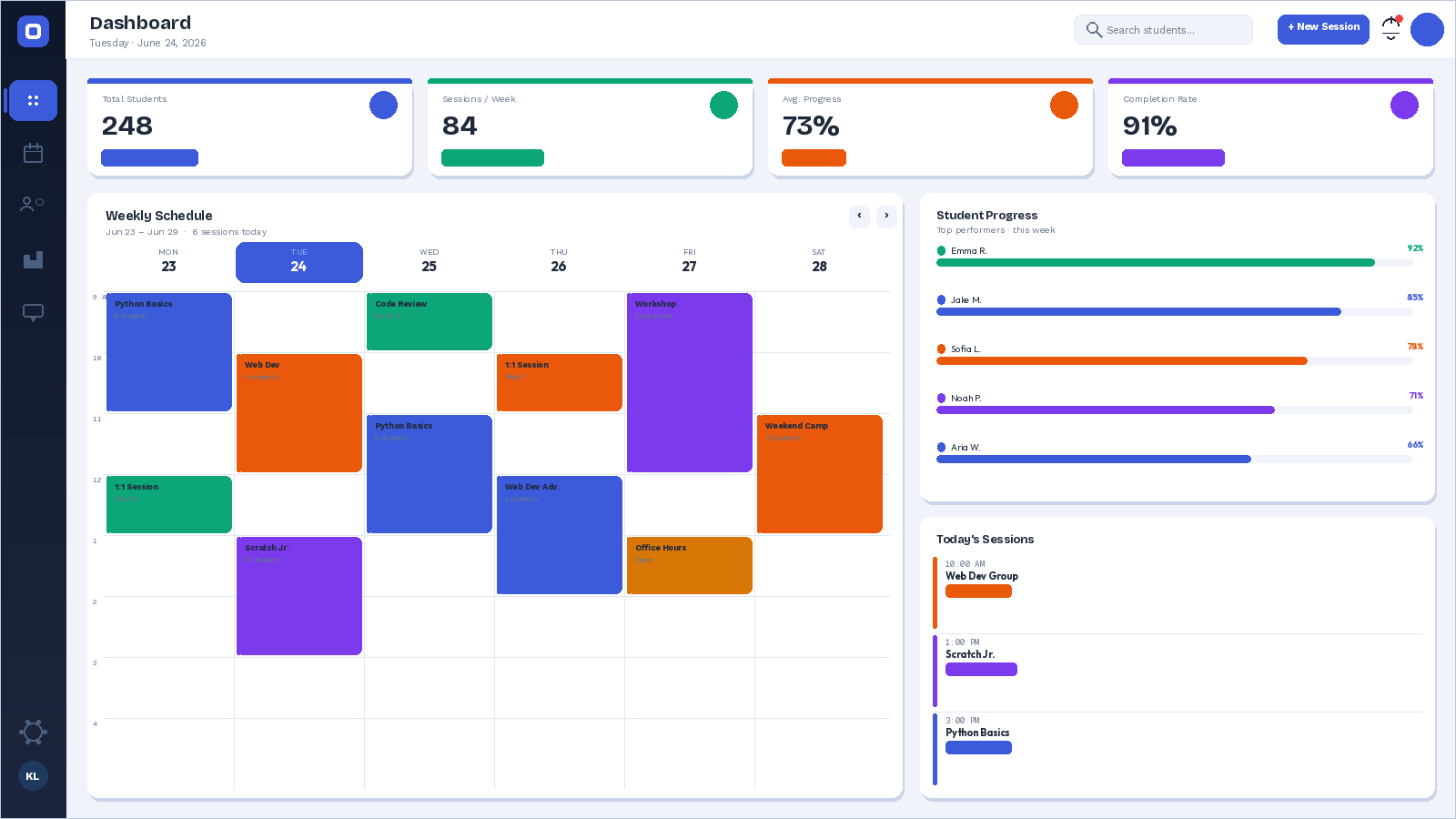
    eTalk.ai ships as a white-label platform — your domain, your logo, your brand colors. Under the hood it handles everything a growing franchise touches daily:

    • CRM: students, tutors, referrals, lead pipeline
    • Scheduling & attendance — with Zoom integration
    • Payments & invoicing — Stripe, tutor payouts, branch-level reporting
    • AI-powered LMS — drop a PDF, get a full curriculum
    • Live, self-paced, and blended learning formats
    • Communications — built-in chat, SMS, email notifications
    • Multi-branch management — each location isolated, franchise overview included

    The multi-branch advantage

    A head-office owner can see aggregate enrollment, revenue, and attendance across all branches while each branch manager sees only their own data. Permissions, brand assets, and pricing can be standardised across the network or varied by location — without a single line of custom code.

    Time to live: Most eTalk.ai franchise onboardings complete in under two weeks. Compare that to 8–14 months for an in-house build, or the 3–6 months typically lost iterating on a vibe-coded MVP before realising it won’t scale.

    “We replaced five separate tools with eTalk.ai and launched our branded school in a weekend. Scheduling, payments, and our LMS finally live in one place.”

    — Andrii Plusnin, Owner, Kids Coding Online

    Side-by-side: every dimension that matters

    Dimension⚡ Vibe Coding🏗 In-House Dev✦ Niche SaaS
    Time to launchDays (proto) / months (prod)8–14 months min.Days to 2 weeks
    Upfront costNear-zero$200k–$500k+Low / subscription
    3-year total cost$50k–$120k (inc. rewrites)$800k–$1.5M+$30k–$80k (predictable)
    Multi-branch supportMust be custom-builtFully customBuilt-in, franchise-ready
    White-label brandPossible (DIY)Fully customNative white-label
    LMS / CurriculumNot includedBuild yourselfAI-powered, included
    Payment & payrollNot includedBuild yourselfStripe + tutor payouts
    Security & complianceYour responsibilityYour responsibilityMaintained by vendor
    Support & SLANoneInternal team onlyDedicated support
    Scales to 50+ branches?Unlikely without rewriteYes (if architected well)Yes, franchise-native
    Ideal forProof-of-concept only50+ branch networks10–50 branch franchises

    🏆 The verdict for a 10-branch franchise

    For a language school franchise operating 10+ locations, Niche SaaS is the asymmetric bet — you pay a fraction of the in-house cost, launch in days instead of months, and get a platform designed specifically for how language schools bill, teach, and retain students.

    Vibe coding belongs at the idea-testing stage, not the operations stage. In-house development makes sense only when you have the revenue, team, and genuine need for a platform you intend to productise and sell to others.

    The question isn’t “which option gives us the most control?” It’s “which option lets us focus on teaching languages while our tech quietly scales underneath us?” For 10–50 branch franchises in 2026, that answer is a purpose-built SaaS like eTalk.ai.

    Quick decision guide

    ⚡ Choose Vibe Coding if…

    You have a new idea, fewer than 5 students, and are testing whether the concept even works. Treat it as a throwaway prototype, not a foundation.

    🏗 Choose In-House Dev if…

    You operate 50+ locations, have a dedicated CTO, and your business model includes licensing your platform to third parties — not just running schools.

    ✦ Choose Niche SaaS (eTalk.ai) if…

    You run or are building 5–50 branches, want your managers focused on students not spreadsheets, and need scheduling + payments + LMS + CRM working together out of the box — under your own brand. Start free →

  • Best Software for Online Coding Schools in 2026

    Best Software for Online Coding Schools in 2026

    Running an online coding school for kids means wearing every hat at once. You teach, plan curriculum, chase payments, coordinate with parents, and still try to grow enrollment. The real bottleneck for most coding school owners isn’t the teaching — it’s the admin: messy booking, missed payment reminders, and spreadsheets that break the moment you add a second teacher.

    The demand for kids’ coding education is accelerating. Coding literacy is now considered a core skill alongside reading and math, and private coding tutoring has grown sharply as schools struggle to keep pace. But many small coding schools still run on manual systems. Switching to the right platform can cut admin work by over 60%, letting you focus on what actually grows your school: great lessons and happy students.

    This guide covers the best management software for online coding schools in 2026 — what each does well, who it’s best for, and how to choose the right one.


    How We Built This List

    We evaluated platforms based on how well they serve the specific needs of live, online coding education for kids — group class support, parent communication, automated billing, and the ability to run a branded experience without stitching together five different tools. Here’s what we focused on:

    • Easy scheduling for 1-on-1 and group coding classes
    • Automated billing and smooth payment collection
    • Parent and student communication tools
    • Reporting for tracking revenue and student progress
    • White-label or branded options (important for school identity)
    • Quick setup — you shouldn’t need a developer to go live

    Top 6 Platforms for Online Coding Schools (2026)

    SoftwareBest ForStarting PriceFree Trial
    eTalk.aiAll-in-one white-label platform for coding schoolsFree (Starter) / $250/mo (Growth)30 days
    WiseLive online classes with group billingContact for pricingYes
    TutorBirdSolo coding tutors and micro-teams$14.95/month30 days
    TeachworksSmall centers needing modular admin toolsUsage-basedYes
    TutorCruncherAgencies managing multiple tutorsPay-as-you-goYes
    NotoTest-prep and tutoring centers with ACH needsTiered plansYes

    1. eTalk.ai — Best All-in-One Platform for Coding Schools

    eTalk.ai is built specifically for education businesses that want everything under one roof — live classes, payments, an LMS, and a branded student experience — without hiring a developer or stitching together multiple tools. For online coding schools, it solves the most common operational pain points at once: manual scheduling, unpaid invoices, scattered student data, and the absence of a proper branded school identity.

    What makes eTalk.ai stand out for coding schools specifically is its white-label approach. Your students see your school’s name, logo, and domain — not a third-party tool. This matters when you’re building a brand parents trust with their children’s education.

    What it does well for coding schools:

    • Automated scheduling for 1-on-1 and group coding classes: Book, reschedule, and manage sessions without back-and-forth. Native Zoom integration means every class gets a one-click join link automatically. Smart workflows confirm bookings, send reminders, and manage waitlists.
    • AI-powered LMS: Upload a coding curriculum PDF and eTalk.ai auto-builds modules, quizzes, and learning paths. Perfect for kids who need to review concepts between classes.
    • Payments and tutor payouts: Stripe-powered invoicing, subscriptions, and automated tutor payout calculations. Supports 150+ currencies. PCI-DSS and GDPR compliant out of the box.
    • Student and Teacher CRM: Track every lead, active student, and tutor in one place. Live progress tracking and at-risk flags mean no student slips through the cracks.
    • Full white-label branding: Your domain, your logo, your payment gateway. Students and parents never see the eTalk.ai name.
    • E-commerce and marketplace: Sell live classes, hybrid courses, or digital coding resources through a branded catalog. Referral portals turn parents into enrollment channels.

    “We replaced five separate tools with eTalk.ai and launched our branded school in a weekend. Scheduling, payments, and our LMS finally live in one place.” — Andrii Plusnin, Owner, Kids Coding Online

    Best For: Coding schools of any size that want a branded, all-in-one platform

    Pricing: Free Starter plan (up to 5 teachers, 30 students) | Growth plan at $250/month | Scale plan (contact for pricing)

    Free Trial: 30 days, no credit card required. Live in approximately one day.


    2. Wise

    Wise is designed for live online educators who need a single platform for session scheduling, payment collection, and group class management. It removes common friction points like manual booking and untracked attendance, making it a solid option for coding tutors who run frequent group sessions.

    • Tutor availability management with automated booking confirmations and recurring sessions
    • Automated session reminders via email and messaging to reduce no-shows
    • Group class support with per-student attendance tracking and group billing

    Best For: Small coding schools running live online group and 1-on-1 sessions | Starting Price: Contact Wise directly


    3. TutorBird

    TutorBird is a straightforward, affordable platform built for solo tutors and small teams. Flat $14.95/month pricing with all features included makes it a low-risk starting point for independent coding tutors.

    • Flat-rate pricing — no per-student or per-session charges as you grow
    • Google and Outlook calendar sync to prevent double-bookings
    • Automated invoicing with Stripe and PayPal integration
    • 30-day free trial with a money-back guarantee

    Best For: Solo coding tutors or tiny teams | Starting Price: $14.95/month


    4. Teachworks

    Teachworks is built for small tutoring centers that need granular admin control. Its modular system with 60+ add-ons lets you configure only what you need.

    • Automatically creates invoices from your session calendar
    • Usage-based pricing keeps costs low at small scale
    • Student progress tracking with parent-facing reports
    • Automatic attendance and lesson detail recording

    Best For: Small coding centers managing 5–50 students | Starting Price: Usage-based


    5. TutorCruncher

    TutorCruncher is built for agencies managing multiple tutors and high booking volume — useful for coding schools that operate like a marketplace, matching students with different coding instructors.

    • Tutor matching by subject, availability, and location (great for Python, Scratch, web dev specialists)
    • Automated reminders and real-time conflict detection across multiple tutors
    • Built-in marketplace to display tutor profiles and accept inquiries
    • Flexible payroll models including per-student rates and revenue sharing

    Best For: Coding school agencies managing 3+ tutors | Starting Price: Pay-as-you-go, 3.5–3.85% transaction fees


    6. Noto

    Noto’s key advantage is low-cost ACH payments (~0.5% vs. typical 3% card fees), which can meaningfully improve margins for schools processing high monthly payment volume.

    • ACH payments at ~0.5% vs. 3% card fees
    • Built-in CRM captures inquiries and routes them into a follow-up pipeline
    • Combines scheduling, billing, and CRM in one system
    • Staff management tools for tracking tutor hours and availability

    Best For: Coding centers processing significant payment volume | Starting Price: Tiered plans, contact Noto


    What to Look for in Software for Your Coding School

    Scheduling and Session Management

    Look for automated booking, recurring session support, calendar sync, and conflict prevention. For coding schools, group class management — tracking which kids are in which class, at which level — is particularly important.

    Billing and Payment Automation

    Your platform should automatically generate invoices, collect payments, send reminders, and enforce cancellation policies. Chasing unpaid invoices manually is one of the biggest time drains for small coding school owners.

    Parent and Student Communication

    Parents of young students expect regular updates. Look for automated reminders, progress reports, and easy-to-access portals. Good communication directly improves retention — and referrals.

    Branding and Student Experience

    For coding schools that want to build a recognizable brand, white-label platforms matter. A professional, branded experience signals quality to parents and builds long-term trust.


    How to Choose the Right Platform

    • Solo coding tutors running 1-on-1 sessions: start with TutorBird — low overhead, easy setup.
    • Schools running group classes (the most common model for kids’ coding): eTalk.ai or Wise are the strongest options.
    • Schools that want a branded experience — your own domain, logo, payment gateway: eTalk.ai is the only platform on this list with full white-label capability.
    • Agencies managing multiple coding instructors with matching and payroll requirements: TutorCruncher or eTalk.ai’s Scale plan.
    • Schools processing high payment volume: evaluate Noto for its ACH fee savings.

    Whatever you choose, commit to one platform fully. Partial setups create errors, confusion, and extra work that erases the benefit of switching.


    Final Thoughts

    The admin load of running an online coding school grows with every student you add. The right software clears that backlog and keeps it clear. For most online coding schools — especially those teaching kids in group formats — the strongest all-around choice is eTalk.ai. It’s the only platform that combines live class scheduling, an AI-powered LMS, full payment automation, and complete white-label branding in a single product. You can be live with a fully branded coding school in about a day, with no developers required and a free 30-day trial.


    Frequently Asked Questions

    What is tutoring management software?

    A tool that manages scheduling, billing, payments, parent communication, and student tracking in one place — replacing spreadsheets and manual work.

    What’s the best software for a small online coding school?

    For solo coding tutors, TutorBird is simple and affordable. For schools running group classes or wanting a branded platform, eTalk.ai is the stronger all-in-one option.

    How much does coding school management software cost?

    Prices range from free (eTalk.ai Starter) to $14.95/month (TutorBird) to $250/month (eTalk.ai Growth). Some platforms charge per session or take a transaction percentage instead.

    Can these tools reduce student no-shows?

    Yes — automated reminders typically reduce no-shows by 40–50%, which directly protects revenue and keeps kids engaged in their coding progress.

    Do I need separate software for online and in-person classes?

    No. Platforms like eTalk.ai handle live online, hybrid, and in-person classes from a single system — keeping all your data and billing in one place.